Gestalt Language Processing

Understanding your child’s journey from whole language chunks to flexible, self-generated communication

Some children learn language word by word. Others begin with whole phrases, scripts and chunks of language.

This is known as Gestalt Language Processing (GLP).

At Happy Chatters, we help families understand what their child’s language may be communicating and support them as their language becomes increasingly flexible, spontaneous and self-generated.

Have you noticed your child repeating phrases from favourite programmes, songs or books?

Perhaps they repeat something you have said before, use the same phrase in different situations, or say a long string of words with a very recognisable rhythm or intonation.

You may have heard this described as echolalia or scripting.

For some children, these repeated phrases can be meaningful units of communication and part of the way they are developing language.

These children may be described as Gestalt Language Processors (GLPs).

A different way of developing language

Some children begin with individual words and gradually combine them:

“car” → “red car” → “The red car is going fast.”

A gestalt language processor may initially acquire a whole phrase or chunk of language connected to an experience or feeling.

For example, a child might say:

“Here we go again!”

every time someone starts the trampoline.

The phrase may originally have been heard somewhere completely different, but for that child it may now communicate:

“Something exciting is starting!”

This is why we want to look beyond the words themselves and ask:

What might my child be communicating through this phrase?

Does this sound like your child?

Your child may:

  • repeat lines from favourite programmes, films, books or songs
  • repeat phrases they have heard adults use
  • use the same phrase in several different situations
  • use long strings of language that can sometimes be difficult to understand
  • have very expressive or sing-song intonation
  • use a phrase that doesn’t immediately seem to match the situation
  • find familiar phrases easier than creating a completely new sentence
  • begin changing parts of familiar phrases to make something new
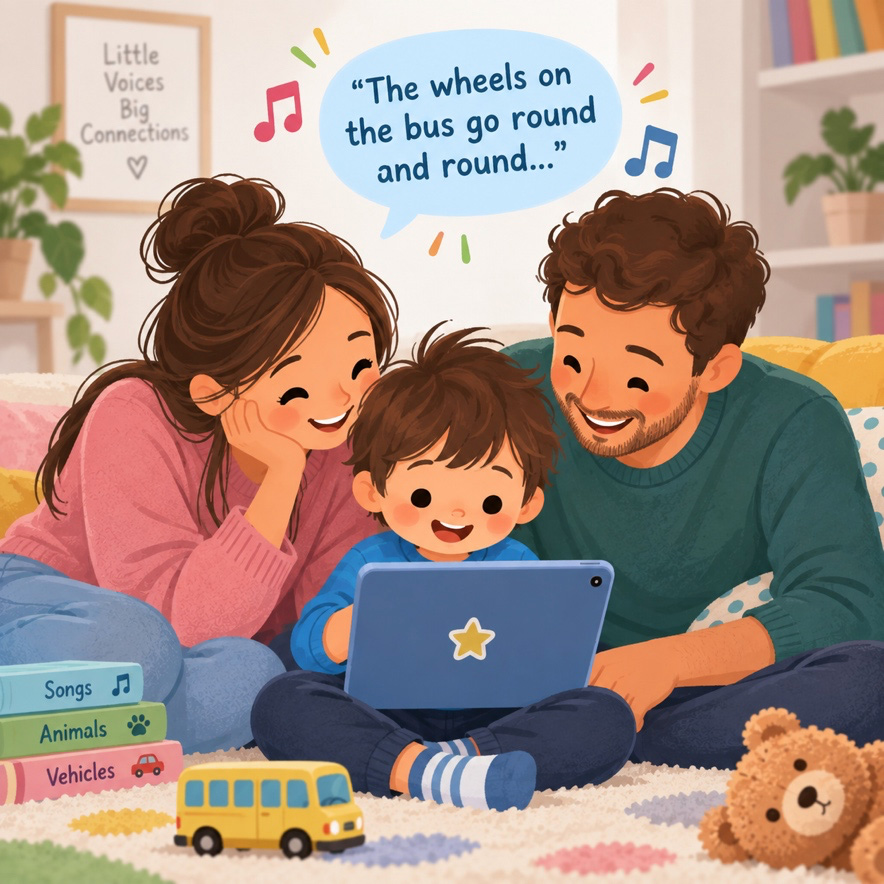
wheels on the bus -Gestalt Language Processing

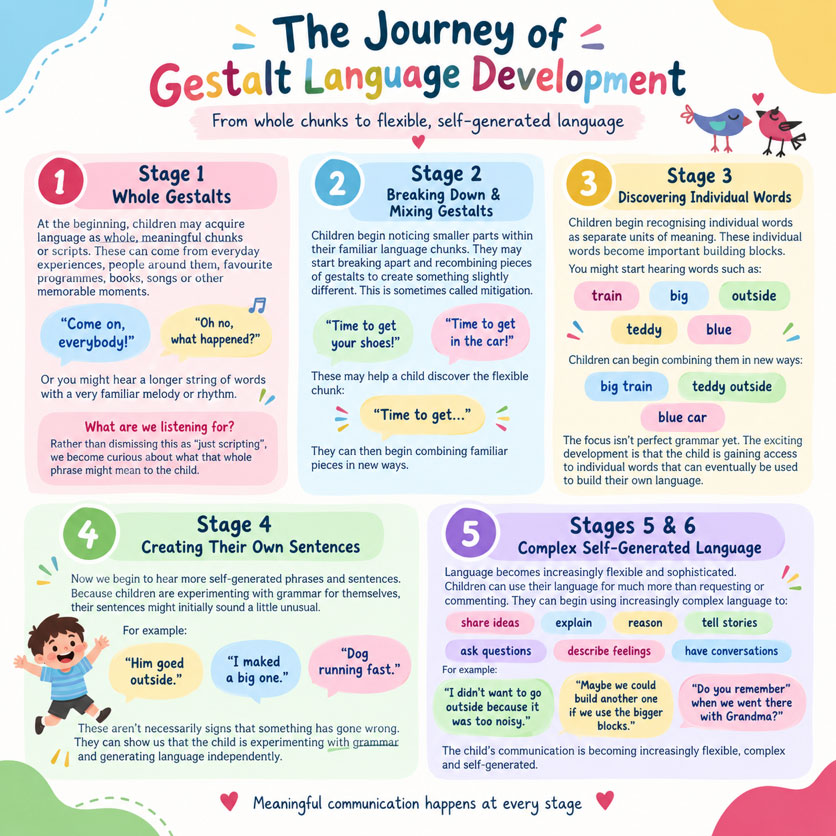
The Natural Language Acquisition (NLA) framework describes six stages of language development associated with gestalt language processing.

The journey begins with whole, meaningful language chunks and moves towards increasingly flexible and self-generated language.

Children may show language associated with more than one stage, and every child’s communication journey is individual.

Most importantly, meaningful communication can happen at every stage.

the-journey - Gestalt Language Processing

At Happy Chatters, we don’t simply focus on stopping scripts or replacing a child’s existing language with what adults think they should say.

We listen first.

We consider the child’s spontaneous communication, interests, play and everyday experiences, as well as when and why particular phrases are being used.

This can help us better understand what their language may mean and how they are currently developing language.

Depending on the individual child, support may include helping families to:

  • understand the meaning behind scripts/gestalts
  • model useful, meaningful and flexible language
  • support children as they begin breaking down and recombining language
  • develop individual words as building blocks
  • support increasingly self-generated language and grammar
  • create natural opportunities for communication through play and everyday routines

And importantly, we work collaboratively with parents and caregivers, so support doesn’t exist only within a  session.

Children learn language through meaningful interactions and experiences, something that is also at the heart of the Happy Chatters resources.

That’s why our sessions are responsive, playful and individualised.

We follow the child’s interests, notice what is meaningful to them and create opportunities for connection and communication through activities they genuinely enjoy.

The aim isn’t to take away the language your child already has.

It is to understand it, recognise its communicative value and support your child to develop an increasingly flexible way of expressing what they want to say.

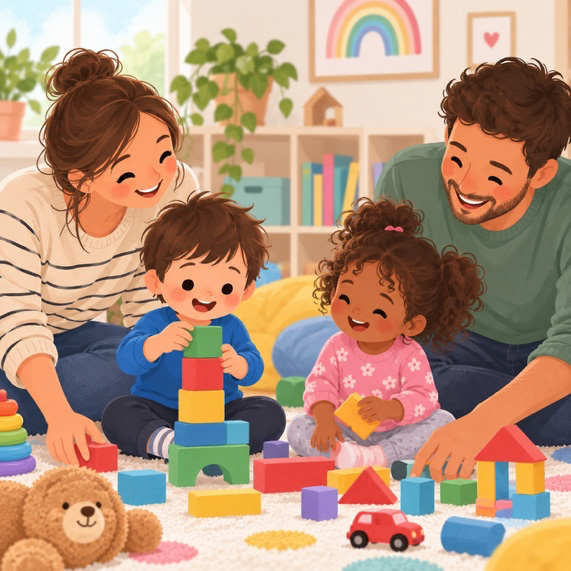
how happychatters can help -Gestalt Language Processing

Is scripting the same as Gestalt Language Processing?

Not always. Some children who are Gestalt Language Processors use lots of scripts or repeated phrases, but scripting on its own doesn’t necessarily mean that a child is a Gestalt Language Processor.

We look at the bigger picture, how your child communicates, understands language and uses words and phrases in everyday life.

Should I stop my child from scripting?


Usually, rather than immediately stopping or correcting a script, we encourage parents to think about what their child might be trying to communicate.

You might notice when they use the phrase, what was happening at the time, or how they were feeling. Sometimes a familiar phrase can be a child’s way of asking for something, sharing excitement, expressing a feeling or responding to a situation.

Once we understand what the script may mean for your child, we can think about the best way to respond and support their communication.

Are gestalts meaningful?


Yes, they can be. A phrase that sounds unrelated to us may have a very clear meaning to your child.

For example, a child may repeat a line they heard in a favourite programme because they connect that phrase with a particular feeling, person or experience.

This is why getting to know your child and the situations in which they use particular phrases is so important.

Does my child have to complete every stage?

No. Language development isn’t a checklist and children don’t all develop language in exactly the same way.

A child may use different types of language at the same time, and their communication can change as they develop.

Our focus isn’t on getting your child to “pass” a particular stage. It’s on understanding how they communicate and helping them develop language that becomes increasingly meaningful, flexible and useful in their everyday life.

How can I find out whether my child may be a Gestalt Language Processor?

You may have noticed that your child uses lots of repeated phrases, scripts, echolalia, or language they have heard in songs, videos or television programmes. Or perhaps you simply feel that their language is developing differently from what you expected.

At Happy Chatters, we can look at your child’s overall communication and language profile with you. We’ll explore how they currently communicate, what their language may mean and how you can support their communication in everyday situations.

You don’t need to work this out on your own, if you have questions about your child’s language development, get in touch with us and we can talk through your concerns.

Contact Us
faq - Gestalt Language Processing